
Throughout the 1970s and 80s Shirley Cameron often asked strangers to look after her twin daughters while she did a performance; the organisers didn’t provide childcare and she felt she had no alternative. But she also invited the children to be part of the work, as collaborators, contributing to the unruly spirit of its making.
Cameron began her art journey at Sutton Art School (1959 – 62) and St. Martins School of Art (1962 – 66). After she graduated and took up a studio in Stockwell with other St Martins graduates, she was the only female sculptor in the group “The first sculpture exhibition they put on, they didn’t invite me to take part.”1 It didn’t seem to be spiteful, she says, maybe they just didn’t think about it.
Working frenetically throughout the 1960s and 70s, Cameron developed a performance art practice that largely existed outside established gallery contexts, presenting work at a slew of festivals, agricultural fairs, arts centres, parks, protest sites, shops, hospitals, libraries, schools and art schools. She worked with theatre groups, other performers, her twins (Lois and Colette Cameron-Miller), partner (Roland Miller) and friends to make what might be called ‘communal sculpture’, a form of activity that included stage-set design, photography, installation and site-responsive performances.
In 1977, Cameron was invited to take part in an art festival in the small town of Caldas da Rainha in east Portugal. She had prepared something in dialogue with the writer Angela Carter who was a friend travelling with her, but the work, called Washing the Twins, was largely made in response to what she found in the sculpture park. “There was a rather lumpy sculpture of what looked like naked twins2. I had this idea that I would wash my actual twins while Angela washed the sculpture, then I put clean clothes on my girls and she put clothes on the sculpture. The museum people weren’t very pleased.”3
When reflecting on the power of the work years after the event, Cameron said that time has lent it a poignancy reflected in the permanence and mutability of each set of twins: “The sculpture still stands in the park in Portugal while we human participants are much changed.”4 There is also the fact that Washing the Twins involved a female artist taking on the work of a male artist with humour and a lightness of touch. The performance was a kind of anti-monument that pricked a pin in the bombast and pomp of classical sculptural language and traditions. Performed on a sunny afternoon, spectators lying around on the grass, enjoying a family day out, it was received with much gaiety and good spirit. But, like much of Cameron’s work, there was a subversive element lurking beneath the surface, one that referenced women’s labour, the exclusion of female artists, and unwritten rules about the way we treat, and interact with art.
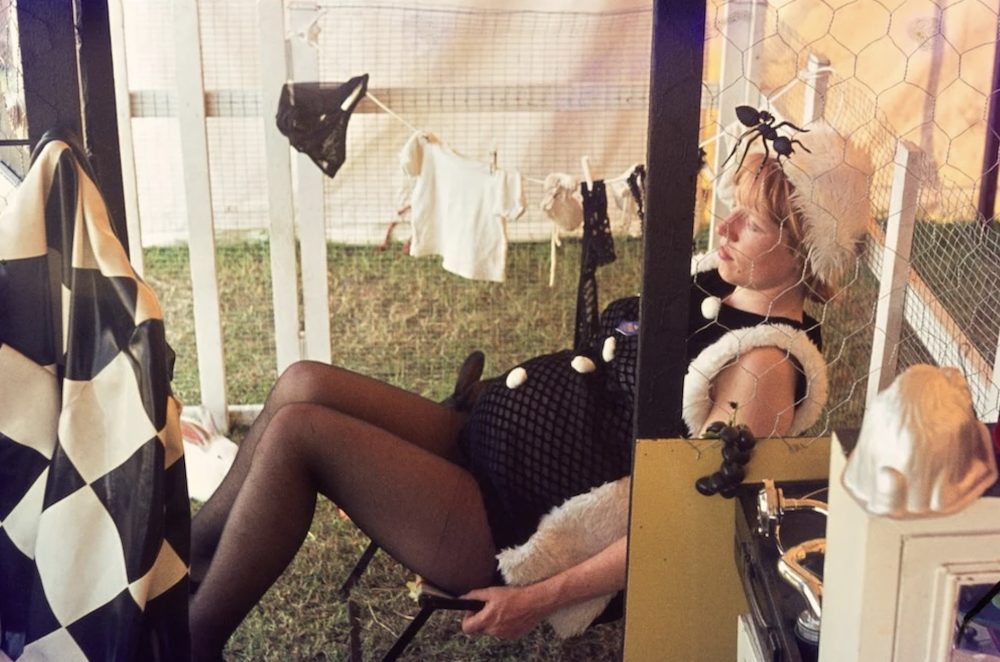
This bold, responsive approach to making performance art was an ongoing form of experimental practice for Cameron. Three years earlier, when she was pregnant with her twins, she staged one of her most provocative works to date. She didn’t see pregnancy as an imperative to pause her practice, but rather found a way to introduce it into her work. Rabbits – the Pregnant Bunny Girl and Mrs Rabbit (1974) saw Cameron dress up as a pregnant bunny girl – replete with black and white leotard, black stockings, white cap and fluffy slippers – and situate herself in a cage with actual rabbits, in agricultural shows across England5. Performing as an animal on display, the work upended the idea of a sexy female entertainer (they aren’t supposed to be pregnant!), and introduced the idea of pregnant women being traded like cows. It was sinister, funny and genuinely groundbreaking. At one point, she put music on and danced. “It was a bit shocking for the teenage boys” she says wryly6.
No doubt, for the director of the Parque Dom Carlos I sculpture park in Caldas da Rainha, Cameron’s twins performance constituted a form of destruction, desecrating both the work of Leopoldo de Almeida and the rules of public art. But perhaps it is more interesting to view it as a form of destruction as radical activism; one artist taking on the work of another artist in order to critique social constructs and forge a link between the fight for free childcare and equal pay to the systematic exclusion of women from the art world.