It’s hard to get your head around, but the Ukrainian Orthodox Church supports Russia’s full-scale invasion of Ukraine1. Members actively distort socio-political conditions in the country and back Russian troops in the seizure and occupation of Ukrainian territories. The church is widely viewed as a tool of the Kremlin’s information and propaganda strategy which aims to undermine Ukrainian identity by rejecting the notion of a sovereign Ukrainian state.
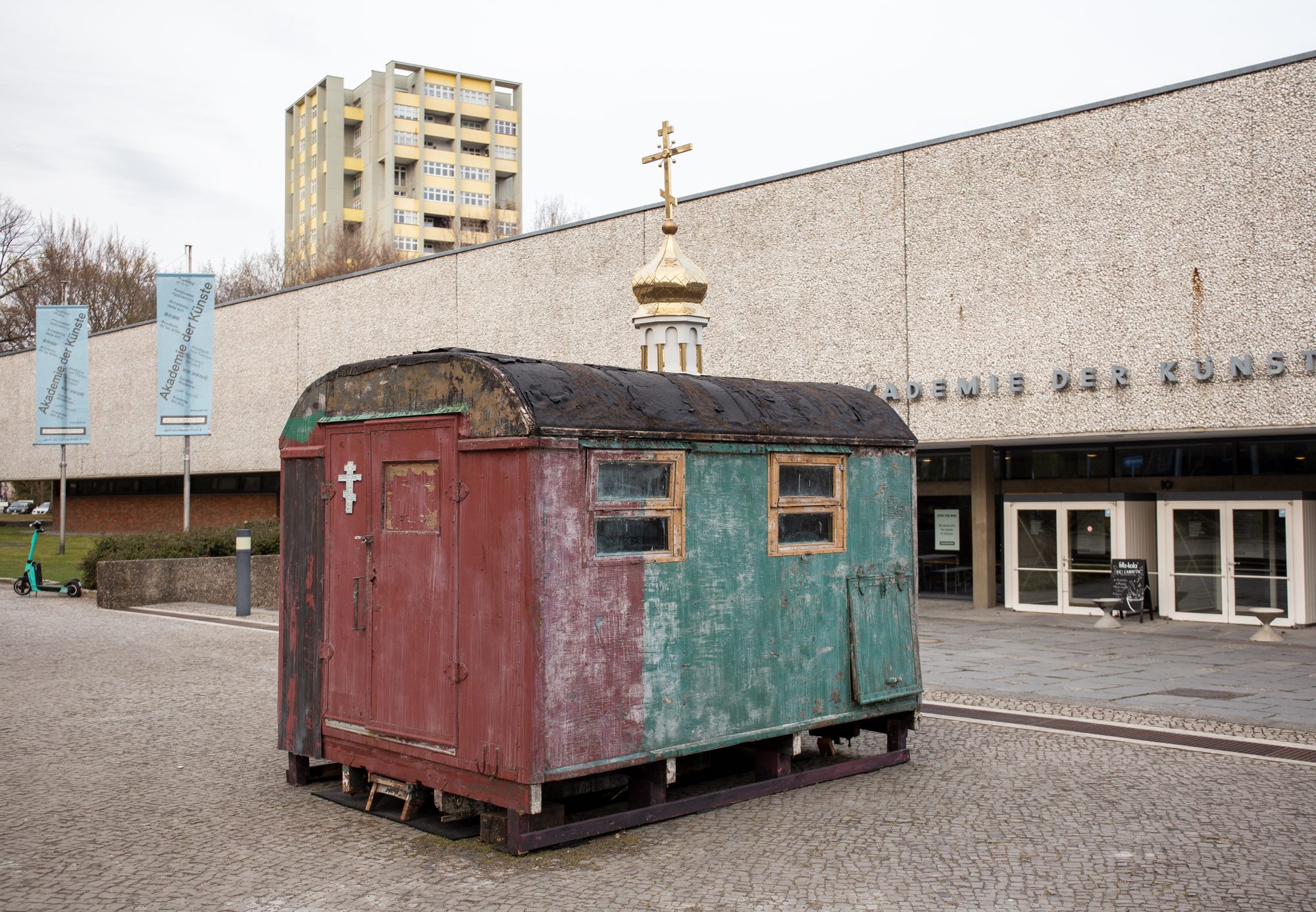
A month after the war began in 2022, Ukrainian artist Sasha Kurmaz installed an old Soviet military truck outside the Akademie der Künste in Berlin, as part of the exhibition What Matters.2 He put a shiny gold crucifix on the roof of the decaying structure, and displayed a selection of Ukrainian Orthodox religious artefacts including candles, icons, crucifixes, and Rushnyks (embroidered cloth used in rituals, religious services and ceremonial events) inside the vehicle. The walls and ceiling, as well as the rusted iron structure, retained their shabby, un-cared for look, mirroring, perhaps the slow erosion, or moral decay, of the Ukrainian Church.
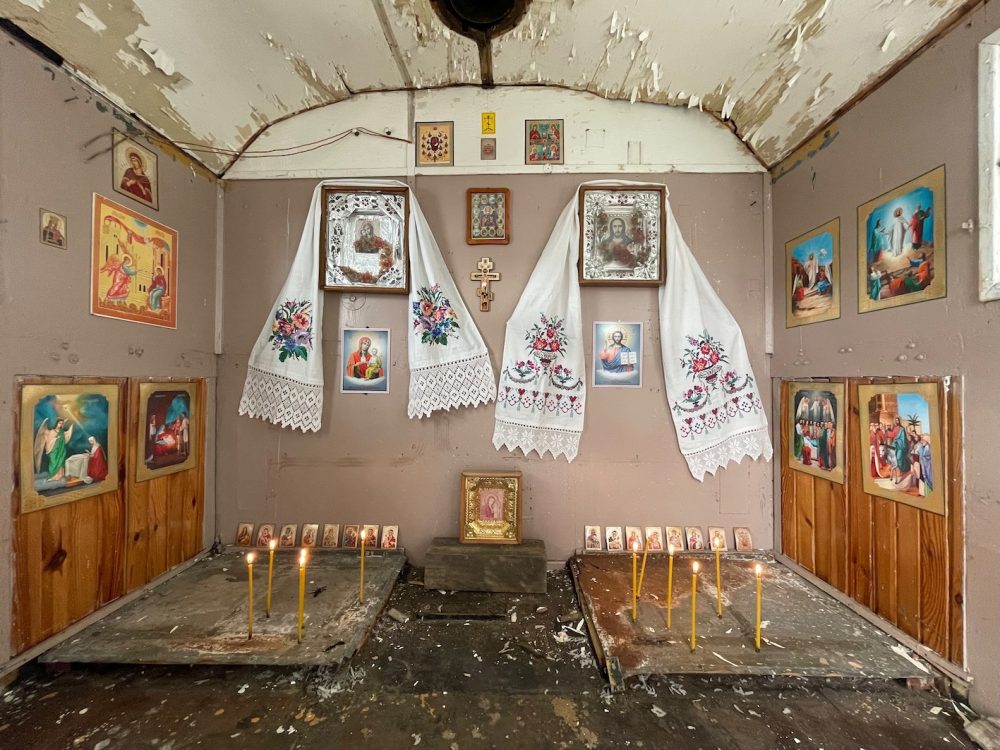
Kurmaz’s truck builds on a long tradition of Orthodox clerics transforming garages, train carriages, vehicles and atypical structures into churches and chapels to transport around Russia and Ukraine. Begun in the late 19th century, mobile worship facilitates access to isolated towns and villages in countries with a vast landmass. The structures are often rudimentary in form but can sometimes reach a surprising level of sophistication, involving air-conditioning units, containers for run-off holy water, as well as altars, lecterns and belfries. It’s a beautiful kind of make-shift, can-do aesthetic, but one that is used here, by the Ukrainian Orthodox Church, to an unethical end.
The work, called The Temple of Transfiguration, began a conversation in Berlin and further afield about the role of the Ukrainian Church in the war. At the outset of the conflict, there was much scepticism in Germany about the ability of Ukraine to withstand the onslaught metered out by the far larger and more powerful Russian army. The response to Kurmaz’s truck reflected this wariness: visitors and passers-by offered little in the way of a response, seemingly unsure of their position, or a body of knowledge they could rely on. Kurmaz says “It seemed to me that everyone was shocked by what was going on and tried to show solidarity and a desire to help on a human level. But there was no understanding at that point that the Russian Orthodox Church had a problematic relationship with Ukraine and Russia.”3 Later, journalists began to investigate and pieces began to appear in the media which clarified the overall picture. “When there were direct calls for a Holy War in 2024 from the head of the Russian Orthodox Church, I think people got a better sense of what was happening” says Kurmaz4.
At the time of writing (2026), Putin’s war shows no sign of abating. The Temple of Transfiguration is being transported to Bingen in south Germany where it will be part of Skulpturen Triennale Bingen. It has assumed the guise of mobile provocateur, moving from one city to the next, echoing the proselytising nature of the original peripatetic churches, but with a radically different intent. It is likely that the public response will be different, perhaps more informed, than the first iteration. Dreams of showing the work in Ukraine are distant, as funding for such initiatives is understandably limited. Kurmaz acknowledges that if it was shown at the beginning of the war in his home country, the work would be considered provocative but today, there would be little controversy. It seems irrefutable that the Ukrainian Orthodox Church’s position is untenable. No faith can justify the violence that the Russian government and the Russian church are committing on Ukraine.
This ongoing provocation raises many important issues (the instrumentalization of religion by power structures; the threat that religious fundamentalism poses to the world; and the ways in which these narratives influence the consciousness of a broader public), but the work’s relation to the subject of destruction is particularly compelling. This manifests in multiple forms: the devastation of Ukrainian communities and cities, the gradual erosion of Kurmaz’s truck, the moral decay of the Ukrainian Orthodox Church, and the potential targeting of the work itself by pro-Russian or Church-aligned actors seeking to advance their own narratives.